
The Botanical Archive · 东方芳香档案
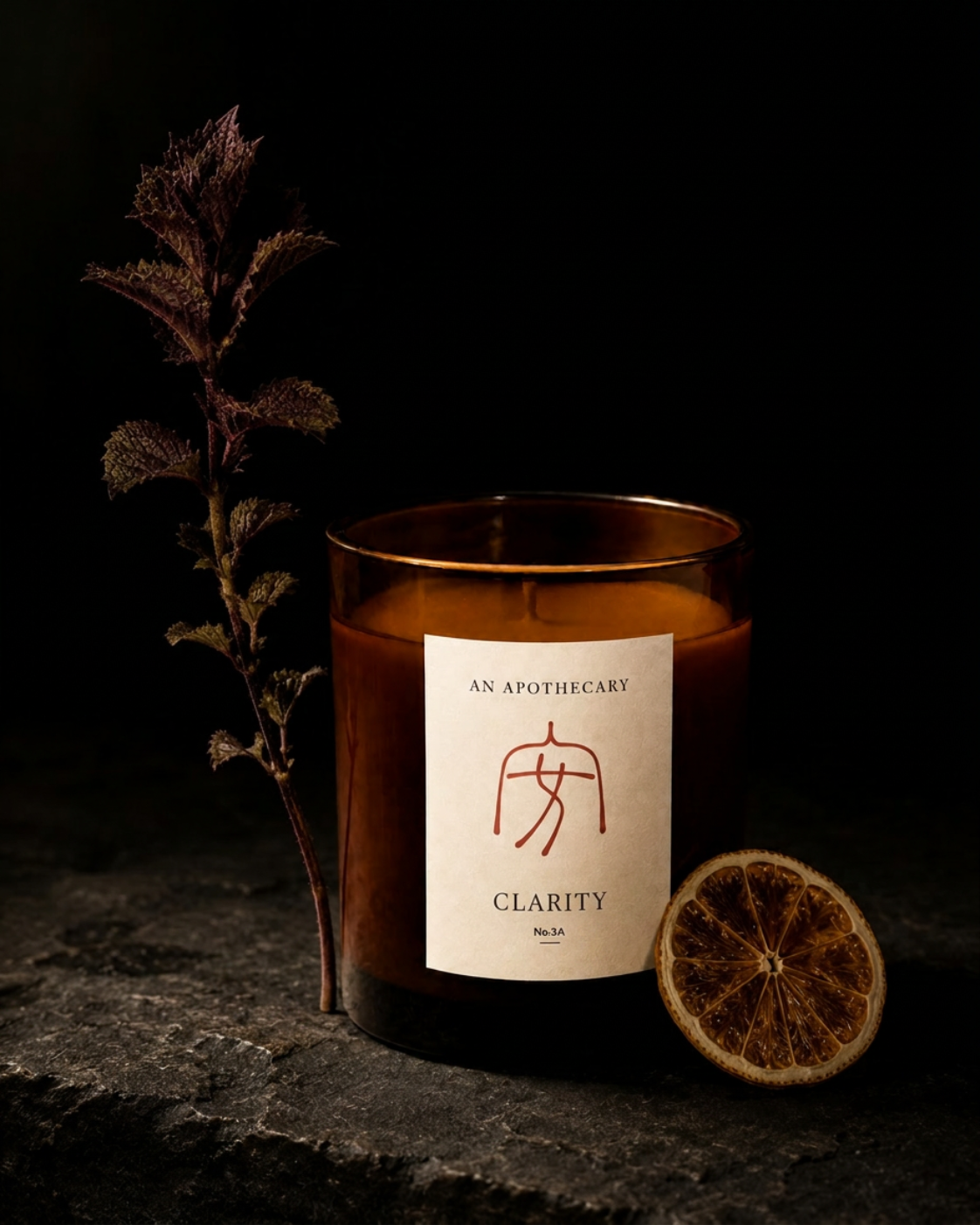
Perilla Leaf and Lemon: The Eastern Green Note Behind CLARITY
Perilla leaf has a green, aromatic character with a slightly spicy edge: the impression of a leaf freshly crushed between the fingers. In fragrance, that herbal identity can be bright without becoming simply minty. Paired with lemon, the leaf gains a sharper outline; in AN’s interpretation, the citrus opens the structure while perilla gives it its particular character.
What is perilla leaf?
Perilla (紫苏, zisu) is Perilla frutescens, a plant in the mint family, Lamiaceae. 紫苏叶 means the leaf material. 芳香中药学 identifies it as the dried leaves, sometimes with young twigs, of this plant. The leaf entry should not be confused with the separate traditional discussion of perilla stems.
Kew’s botanical account also records perilla as a culinary and medicinal herb. Those contexts help explain why the plant carries an identity beyond an abstract “green note.” The fresh leaf, the dried material described in materia medica and its interpretation in perfume are related references, but they are not identical experiences.
Perilla in Chinese herbal tradition
Traditional classification. The textbook describes 紫苏叶 as 辛、温: pungent and warm. It assigns it to 肺、脾, the Lung and Spleen channels within the traditional framework. Its listed functions include 解表散寒 and 行气宽中, conventionally described as releasing the exterior and dispersing cold, and moving qi to ease the middle.
These terms describe how the herb was understood in Chinese materia medica. They are not modern anatomical mechanisms, and they do not establish what happens when someone smells a candle. In particular, 行气 should not be converted into a claim about oxygen, circulation, energy levels or concentration.
There is a useful distinction in the language itself: a leaf can be traditionally classified as warm while being described as bright and green in fragrance. The two descriptions answer different questions. “Green” concerns scent; 温 belongs to the inherited herbal classification.
What makes the green note distinctive?
AN’s olfactory interpretation. Perilla is the sensation of a crushed leaf with a fine spicy edge. In this vocabulary, “fresh” does not mean an icy finish, and “herbal” does not require the scent to resemble a medicine cabinet. The interest lies in keeping the leaf recognisable.
Calling it green is a starting point, not a complete description. Mint, basil, rosemary and perilla should not be treated as interchangeable simply because each can appear in an herbal fragrance. Here, the distinguishing reference is 紫苏叶, with its Chinese name, material history and particular green-spicy identity.
What the chemistry can tell us
The textbook includes a volatile-oil composition for perilla leaf and lists perillaldehyde among its constituents. That is a chemical account of the material reported in the source. It is not a chemical analysis of CLARITY, nor a universal percentage specification for every perilla leaf or extract.
AN uses “lifted” and “directional” as descriptions of the fragrance impression. Those sensory words should not be mistaken for measured evaporation rates or an effect on the person smelling it. A list of molecules alone does not establish the finished scent.
Why pair perilla with lemon?
The leaf supplies the herbal identity; lemon draws a brighter line around it. In AN’s reading, the pairing feels open because the citrus gives the green note definition rather than covering it with sweetness. Cedarwood adds a dry structure beneath that brighter surface.
This is where the composition becomes specific. Lemon is not being asked to promise energy or productivity. Its role is olfactory: to sharpen the edge, open the space and keep the leaf readable. Perilla gives that brightness a botanical vocabulary rooted in the material rather than a generic idea of freshness.
Compare this with angelica root and citrus peel. There, citrus opens an earthy centre. Here, it outlines an aromatic leaf. Similar relationships can serve quite different scent characters.
The modern translation: No.3A CLARITY
AN presents CLARITY through the core story Perilla Leaf · Cedarwood · Pressed Lemon. This is a selected scent story, not an exhaustive ingredient list. The current product description also names tangerine peel and tea tree; the three-note line should not erase those additional references.
The finished composition belongs to a clear beginning: green leaf, a faint peppery edge, citrus and clean woods. “Pressed Lemon” is AN’s existing scent-story wording. It should not be read as independent verification of a particular extraction method.
Before the first task
Open the curtain. Clear a place for the first thing you intend to do. The room can have a deliberate beginning without an elaborate routine. If you choose fragrance, CLARITY can accompany that moment through its green, citrus and woody character.
The name describes AN’s morning setting. It does not promise sharper cognition or improved work performance. Explore No.3A CLARITY, or read about a threshold ritual.
Questions from the archive
What does perilla smell like in perfume?
In AN’s vocabulary, it is green, herbal and lightly spicy. The complete impression depends on the composition: CLARITY places that leaf character alongside citrus and cedarwood.
Is perilla just another name for mint?
No. Perilla belongs to the mint family, but Perilla frutescens is its own botanical identity. Family membership does not make its scent interchangeable with mint.
Is perilla traditionally warming or cooling?
The textbook classifies 紫苏叶 as 温, warm. This is a traditional herbal category, not a claim about the temperature of a room or a physiological effect of fragrance.
Source notes
- Traditional materia medica and reported chemistry: 熊磊、赵毅、解宇环主编,《芳香中药学》,中国中医药出版社,2022. 紫苏叶, printed pp. 31–32. Botanical part, classifications and the presence of a volatile-oil discussion are verified against these pages. Pharmacological findings are not transferred to the candle.
- Botanical identity: Royal Botanic Gardens, Kew, Perilla frutescens, Plants of the World Online.
- AN interpretation: current CLARITY product description and AN Brand Book 2026. The pairing and morning atmosphere are AN’s interpretation. The textbook, its editors and publisher do not endorse AN Apothecary.